|
Cancer Cell Metabolism
The internet is a wonderful
thing, information really becomes available at our fingertips. Like
everything, with the good comes the bad and, when we speak of cancer, a
lot of bad information is unfortunately published. Everybody seems to
have his/her own interpretation of the Warburg theory. In this document
I'll try to clarify what this theory is and what we know about cancer
cell metabolism.
The
Warburg Effect
In 1931 Otto Heinrich Warburg
was attributed the Nobel price in Physiology and Medicine mainly for his
investigation of the metabolism of tumours and
the respiration of cells, and more particularly for his discovery
of the nature and mode of action of respiratory enzymes. He edited and
has much of his original work published in The Metabolism of Tumours (tr. 1931) and
wrote New Methods of Cell Physiology (1962).
Otto Warburg observed that
cancer cells' metabolism is different than the one of normal adult cells.
Normal adult cells use a small energy plant located inside them to
produce most of their energy needs from oxygen, this is an aerobic
process. In contrast, cancer cells rely mainly on the first part of the
energy production process dependant on glucose
(sugar), this is an anaerobic process. The anaerobic process is called glycolysis.
The paradox is that cancer
cells rely on glycolysis even if oxygen is available. This phenomenon is
called aerobic glycolysis or the Warburg effect.
Many decades later, this
observation was exploited by clinicians to better visualize tumours using PET (positron emission technology)
imaging. But it has not been known exactly how tumour
cells perform this alternate metabolic feat, nor was it known if this
process was essential for tumour growth. Now, two
papers appearing in the March 13 (2008) issue of the journal Nature
help answer these questions. Led by researchers at Beth Israel Deaconess
Medical Centre (BIDMC) and Harvard Medical School, the papers find that
the metabolic process that has come to be known as the Warburg effect is
essential for tumours' rapid growth, and
identifies the M2 form of pyruvate kinase (PKM2), an enzyme involved in
sugar metabolism, as an important mechanism behind this process.
The "Warburg Effect"
is a unique property of most cancers. The phenomenon is characterized by
increased glucose uptake and reliance on glycolysis for ATP production
despite available oxygen source.
Cancer
Cell Metabolism
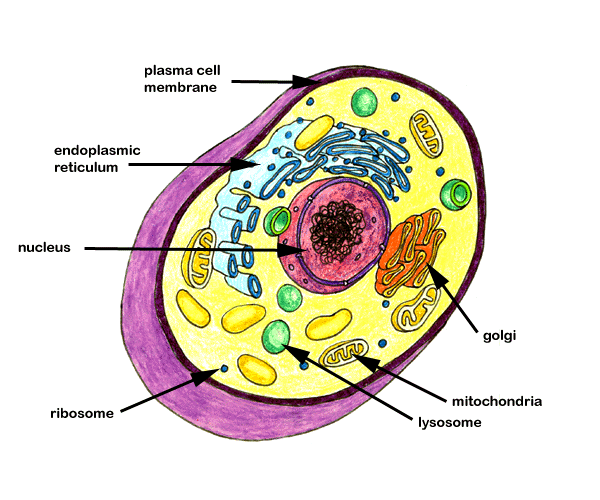
In the above figure, the
yellow coloured part is named cytosol, this is
where the energy production process starts. At first, glucose molecules
are percolating into the cell through the cell membrane by diffusion. You
can imagine the glucose molecule in the yellow part of the cell: the
cytosol. It doesn't stay free very long, it becomes engaged in a
biochemical process to produce what the cells like the best (their favourite food), ATP. This process occurring
in the cytosol is named glycolysis. It is not very efficient, only
two servings (2 molecules) of ATP are available for all cell metabolism
needs. Usually, to satisfy the huge appetite of normal cells, little
power plants also nicknamed Mitochondria take a by-product of glycolysis,
pyruvate, and convert it into 36 servings!! To accomplish
such miracle, mitochondria use oxygen.
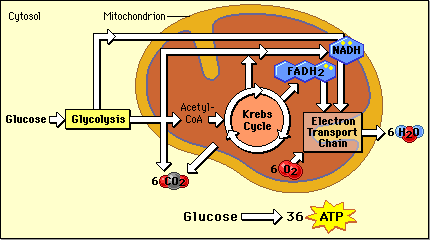
What Otto Warburg discovered
is that most cancer cells rely only on the first part of the energy
process: glycolysis. They use glucose to produce their cell food (ATP).
Their mitochondria are not involved in the cell food production process.
Because they rely on glycolysis which is a less efficient mean of
production (only 2 servings of ATP), they need more glucose to satisfy
their enormous appetite.
Compared to normal cells which
can, from a single molecule of glucose, produce 36 to 38 servings of ATP,
cancer cells will need 19 molecules of glucose to produce an equivalent
quantity (38 ATP = 2 ATP X 19 glucose). From these numbers we can see
that cancer cells will BE huge consumers of glucose to satisfy their
sugar crave. This is why some medical imaging techniques can help us
locate tumours when they reach a certain size.
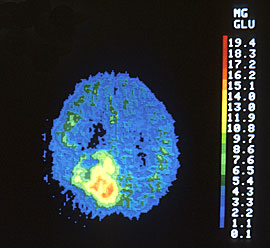
Radio-active glucose is injected in patients. The Positron Emission
Tomography (PET) scan tool is sensible to radio-active material. Since
cancer cell will consume 18 to 19 times more glucose than normal cells,
they will accumulate more radio-active material as illustrated in the
picture below.
|
|
Shown in the left is a
Positron Emission Tomography (PET) scan of a 62 year
old man with a brain tumour. The
irregular bright yellow and orange area in the lower left portion of
the brain indicates the location of the tumour,
which metabolizes glucose faster than normal cells.
|
The
Role of Enzymes in Glycolysis
|

|
The
aerobic glycolysis or the Warburg effect, is thought to be due to the
reprogramming of metabolic genes to allow cancer cells to function more
like fetal cells and to enable a greater fraction of glucose
metabolites to be incorporated into macromolecules synthesis rather
than burned to CO2. In other words, glucose is used more for
replication than for normal cell metabolism.
Recent
research demonstrated that one enzyme makes the whole difference: Pyruvate
Kinase. It is an enzyme involved in the last step of the
glycolysis process.
Pyruvate
kinase exists in two different versions: M1 and M2. The M1 isoform is
expressed in most adult tissues; and the M2 isoform is a slice variant
of M1 expressed during embryonic development(1).
It
has been reported that tumour tissues
exclusively express the embryonic M2 isoform of pyruvate kinase(2,3,4).
|
Given that pyruvate kinase M2
is expressed during embryonic development and in many non-transformed
cell lines, M2 expression alone is unlikely to be a transforming event
Rather, the presence of of PKM2, may contribute
to a metabolism environment that is amenable to cell proliferation.
At the end of the glycolysis
process, the enzyme pyruvate kinase help in the final production of two
molecules of ATP and one molecule of pyruvate. The pyruvate molecule is
then passed to the mitochondria to be transformed into 36
molecules of ATP.
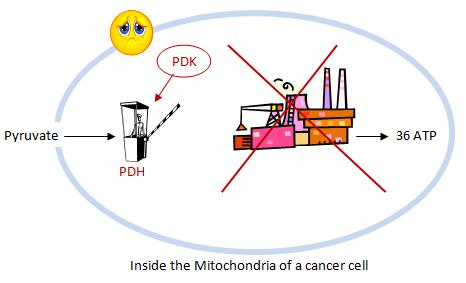
A gatekeeper stands at the
front of the mitochondria, it is a mitochondrial enzyme, the pyruvate
dehydrogenase (PDH). Without the latter, the pyruvate produced by the
glycolysis cannot gets into the highly efficient mitochondria power
plant.
Writing
Notes: I need to review the document
to edit and most probably add new content. I should get more info on DCA.
There is a growing evidence that DCA is very potent for several cancer
cases. I saw more and more well documented remission reports in the last
months. I should add more content about why glycolysis can contribute to
cancer cell proliferation and why some molecules like DCA bring back the
natural life cycle. I also need to add several sections about the
different stages of tumourigenesis. Barry said
that I need to add some content on why active mitochondria lead to
apoptosis because this is the DCA active pathway. I think he is right.
references
(1) Jurica
M.S et al. The allosteric regulation of pyruvate kinase by
fructose-1,6-bisphosphate, Structure 6, 195-210 (1998)
(2) KHeather
R. Christofk et al. The M2 slice isoform of
pyruvate kinase is important for cancer metabolism and tumour growth. Nature vol. 452|13 March 2008.
(3) Mazurek et al. Pyruvate
kinase type M2 and its role in tumour growth
and spreading. Semin. Cancer biol. 15, 300-308
(2005)
(4) Dombrauckas
et al. Structural basis for tumor pyruvate kinase M2 allosteric
regulation and catalysis. Biochemistry 44, 9417-9429 (2005).

|


